IMBA - International Mountain Bicycling Association
What would we do without trails?

Room to Ride - Mountain Bikers to Buy Land in Massachusetts

By Jane Roy Brown. AMC Outdoors Magazine, April 2003. Reprinted with the permission of the Appalachian Mountain Club. Visit them at http://www.outdoors.org/

If someone asks, 'What's the greatest threat to mountain biking?' the answer is 'development,'" says Philip Keyes, executive director of the New England Mountain Bike Association (NEMBA).

That's one of the reasons Keyes says his organization has plunked down $15,000 for a purchase-and-sale option on a hilly, 47-acre tract of boulder-strewn, hardwood forest near the headwaters of the Charles River in Milford, Mass., about 30 miles southwest of Boston. NEMBA needs to close the deal on the $200,000 property by December 31, and, as of early March, had raised $139,000 - all but $4,000 from individual mountain bikers. If the fundraising push succeeds, it will be the first time in the Northeast that a mountain-biking organization has bought land.

"This project is significant because of its leadership by mountain bikers, its professionalism, and its trend-setting potential," says Pete Webber, membership and communications director of the International Mountain Bicycling Association, based in Colorado.

NEMBA is the country's largest regional mountain bike group, with 17 chapters and 4,500 members, almost half of whom also belong to AMC, says Keyes. The organization models itself on AMC, with a three-pronged purpose to promote responsible riding, trail stewardship, and open-space conservation. The group has routinely donated money to land-protection organizations, and "in the last few years we've become very serious about buying open space," he says.

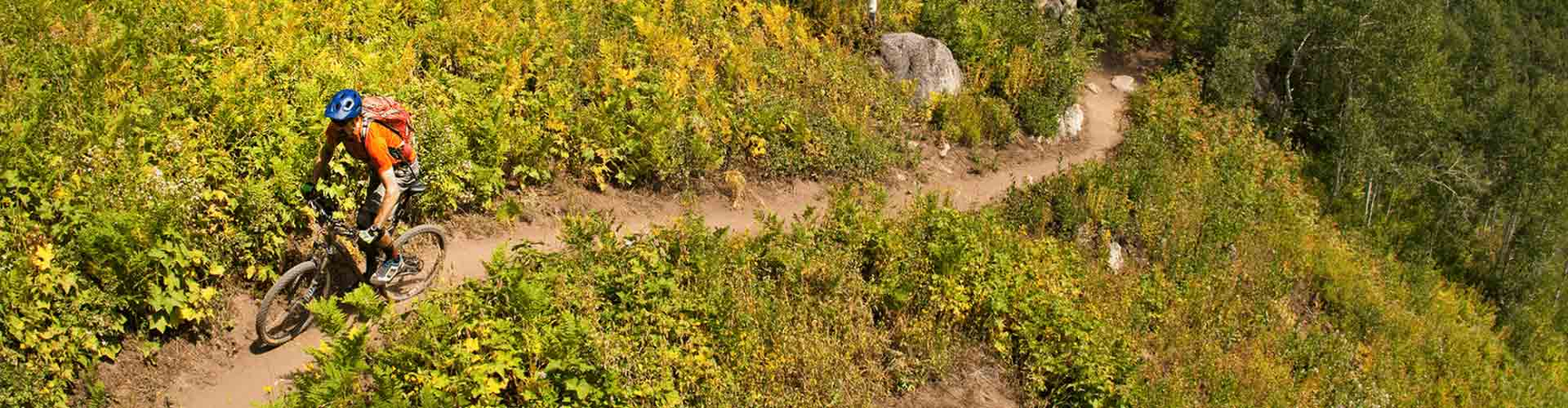
If the purchase goes through, NEMBA will allow free public access for nonmotorized recreation, Keyes says. Because the privately owned land has not been officially managed for many years, it's been a haven for all kinds of recreation: all-terrain and four-wheel-drive vehicles have used it, along with hikers and equestrians. But the parcel is especially beloved by mountain bikers, who have dubbed it "Vietnam," and travel from all over New England to ride its challenging "single track" - the narrow, winding trails sought out by serious riders.

NEMBA plans to create a multi-use trail system on the land, working in some of the existing trails, and designing and building new ones. Despite the fact that the trails won't be designated for separate uses, Keyes doesn't foresee user clashes. "In designing the new trails, if we make them fairly tight and curvy, but with clear sightlines, it will keep bike speed down to about 5 or 6 miles per hour," he says, adding that hikers usually move at 2 to 3 miles per hour, and conflicts typically result from bigger differences in speed and poor sightlines. Horseback riders will probably stick to the relatively flat old Jeep paths they use now.

The NEMBA purchase is part of a bigger project to preserve the Charles River headwaters in the towns of Holliston and Milford, says Robert Buckley, chair of the Holliston Conservation Commission. Initially, the project called for Holliston to buy 210 acres, the state to purchase 125 acres in Milford, and NEMBA to buy its 47-acre tract, also in Milford. These properties lie next to existing conservation lands, and if all the deals went through, they would protect a total of 1,100 acres of contiguous green space for wildlife habitat and recreation. The 125-acre Milford property is now owned by a developer, however, and at press time in early March, it was possible that at least part of that parcel could be built on. All three parcels, which lie within Route 495, a Boston commuter beltway, are ripe for development.

The parties plan to buy the parcels outright and then place them under permanent conservation restrictions (the state's term for what are known elsewhere as conservation easements) to bar all future development. The Trustees of Reservations, a statewide land-conservation organization, will hold the conservation restrictions in perpetuity, regardless of who owns the land.

The state's Department of Environmental Management classifies the land NEMBA plans to buy as "core habitat" for wildlife, including coyotes, deer, fishers, turtles, and amphibians. Keyes says that NEMBA plans to survey the vernal pools on the property to ensure that none of the trails affect them. "We also hope to work with some knowledgeable person to identify flora and fauna populations, but chances are we won't have the funds to commission a full scientific survey."

But the details of managing recreation aren't on the front burner at the moment. Chris Rodstrom, land protection specialist with the Trustees of Reservations who is working on the three land deals, says the priority now is to buy as much land as possible and secure the conservation restrictions. "I think everyone agrees that there are multiple uses of all these properties, and work needs to be done to manage them and to protect plants and wildlife," he says. "At this point, the real concern is that these properties are conserved."

Keyes says NEMBA will post news about its fundraising progress on www.nemba.org.

By Jane Roy Brown. AMC Outdoors Magazine, April 2003. Reprinted with the permission of the Appalachian Mountain Club. Visit them at http://www.outdoors.org/

Email this page Printable Version


Help | Site Map | Copyright
IMBA Homepage Join IMBA Now!