Example: Proposal for Increased Singletrack Access for Mountain Bikes in East Bay Regional Parks
June 11, 2002
Board of Directors
East Bay Regional Parks District
2950 Peralta Oaks Court
Oakland, CA 94605
Re: Mountain bike access to singletrack trails in East Bay Regional Parks
Dear Board:
In 1998, the Bicycle Trails Council of the East Bay (BTCEB) formally requested bicycle access to a select number of East Bay Regional Parks District singletrack trails. It has been four years since this proposal was submitted to the District and no singletrack trails have been opened to bicycles. Public meetings have been held and a trail evaluation tool remains in its draft stages with no target completion date. Four years to make a definitive determination as to whether or not five trails should be opened to bicycles is unacceptable.
On behalf of the over one-thousand East Bay residents who have signed the attached petition, the BTCEB is requesting that the Board of Directors for the East Bay Regional Parks District (the District) expeditiously modify Ordinance 38 to allow for increased mountain bike access to singletrack trails.
Under the current policy, the District is not meeting the recreational needs of many East Bay residents. It is unacceptable to this group of citizens that the District, whose vision calls for "enjoyment and healthful recreation," would maintain a policy that categorizes bicycling as somehow being a substandard form of recreation. Bicycling is an extremely popular form of healthful recreation and many people choose to enjoy public lands on two wheels. Know that, until appropriate trail management policies that address the needs of this large user group are implemented, conflict between users and requests for appropriate access will continue.
Please consider the request by your constituents and the accompanying proposal from the BTCEB and take definitive action to provide for increased bicycle access to singletrack trails within East Bay Regional Parks District Lands.
Sincerely,
Shaun C. Reid
President, Bicycle Trails Council of the East Bay
San Francisco Bay Area Rep, International Mountain Bicycling Association
enclosures
Cc: Board Operations Committee, East Bay Regional Parks District
Tim Blumenthal, Executive Director, IMBA
Jenn Dice, Advocacy Director, IMBA
Dan Vardamis, Advocacy Associate and IMBA Trail News Editor, IMBA
Board of Directors, BTCEB

Proposal for Increased Singletrack Access for Mountain Bikes in East Bay Regional Parks
Submitted by: Bicycle Trails Council of the East Bay
Prepared by: Shaun Reid, President
Date: June 11, 2002
Background
Over twenty years ago, mountain biking began to emerge on the recreational scene. Shortly thereafter, conflict between users began. Trail closures and restrictive policies regarding bike use on trails, particularly singletrack, were common reactions from land managers faced with complaints from user groups. These conflicts and land management policies spawned mountain bike advocacy groups such as our own, ROMP (Responsible Organized Mountain Pedalers), BTC Marin, thousands of other groups around the world, and ultimately the International Mountain Bicycling Association (IMBA), the umbrella organization for mountain bike advocacy worldwide.
These groups have had a profound effect on the practice of mountain biking and on the nature and quality of interactions between users. By adopting, teaching, and practicing responsible riding, conflict and injury between user groups has been greatly reduced.
In 1998, the BTCEB proposed that the District change this outdated policy by opening five singletrack trails to mountain bikes. This gave impetus to the development of a "Bicycle Matrix" to be used to determine the appropriateness of a trail to bicycle access. As we understand it, the Bicycle Matrix is now being called the Trail Checklist. After four years it has yet to be implemented and remains in a draft stage that is unacceptable to a number of users, including cyclists. No target date for its implementation has been provided to us.
Petition
In response to the lack of definitive movement toward additional singletrack access for mountain bikes, several mountain bikers drafted a proposal for an "open unless closed policy." This policy would change Ordinance 38 to say that all trails are open to mountain bikes, except in cases where individual park supervisors determine that they should be closed. The BTCEB fully endorses this proposal. We have assisted these cyclists by supporting a petition, both in paper and on our web site.
The response has been overwhelming; with 1,113 people signing the written petition to date (while most of the petitions have been returned by volunteers, some do remain outstanding) and another 454 people signing the online petition. Of these signatories, over 1,000 are East Bay residents and the others live outside the East Bay, many in neighboring counties. At the time of this writing, an exact breakdown has not been completed since, again, some of the petitions remain in the hands of volunteers. For the purposes of this proposal, East Bay residents are defined as those who live in one of the Districts seven wards. Signatories who did not list their city of residence were considered to live outside the East Bay. Of the 454 people who signed our petition online, 223 are East Bay residents and 231 live outside the East Bay.
This clearly shows that a significant number of East Bay residents support substantially increased bicycle access within the parks. The petition is attached as Appendix A.
Why Mountain Bikes?
Why do mountain bikers need to access trails on bicycles when they could walk? People who feel that mountain biking is an inappropriate form of recreation often ask this question during discussions about mountain bike access. Why do equestrians need to access trails on horseback when they could walk? Why do hikers need to access trails on foot when they could be on bicycle or horseback? These questions are irrelevant to the discussion people are individuals and as such, will have their own personal preferences.
In discussions with other users and land managers, the validity of the sport of mountain biking and the need to provide a location for it are sometimes questioned. The sport is made valid by the very fact that people are doing it every day and the attached petition supports this. People have been riding bicycles on trails since bicycles were invented and they will continue to do so. The sport is muscle powered and of no more harm to the environment than hiking and it is a legitimate recreational need for a significant number of people who use the EBRPD lands. The District must recognize this and address the activity as a legitimate use of public land as is done throughout the Bay Area and the country.
By continuing to endorse a policy that denies cyclists this experience based upon their chosen mode of transport the District is not meeting the needs of its constituency.
Why Singletrack?
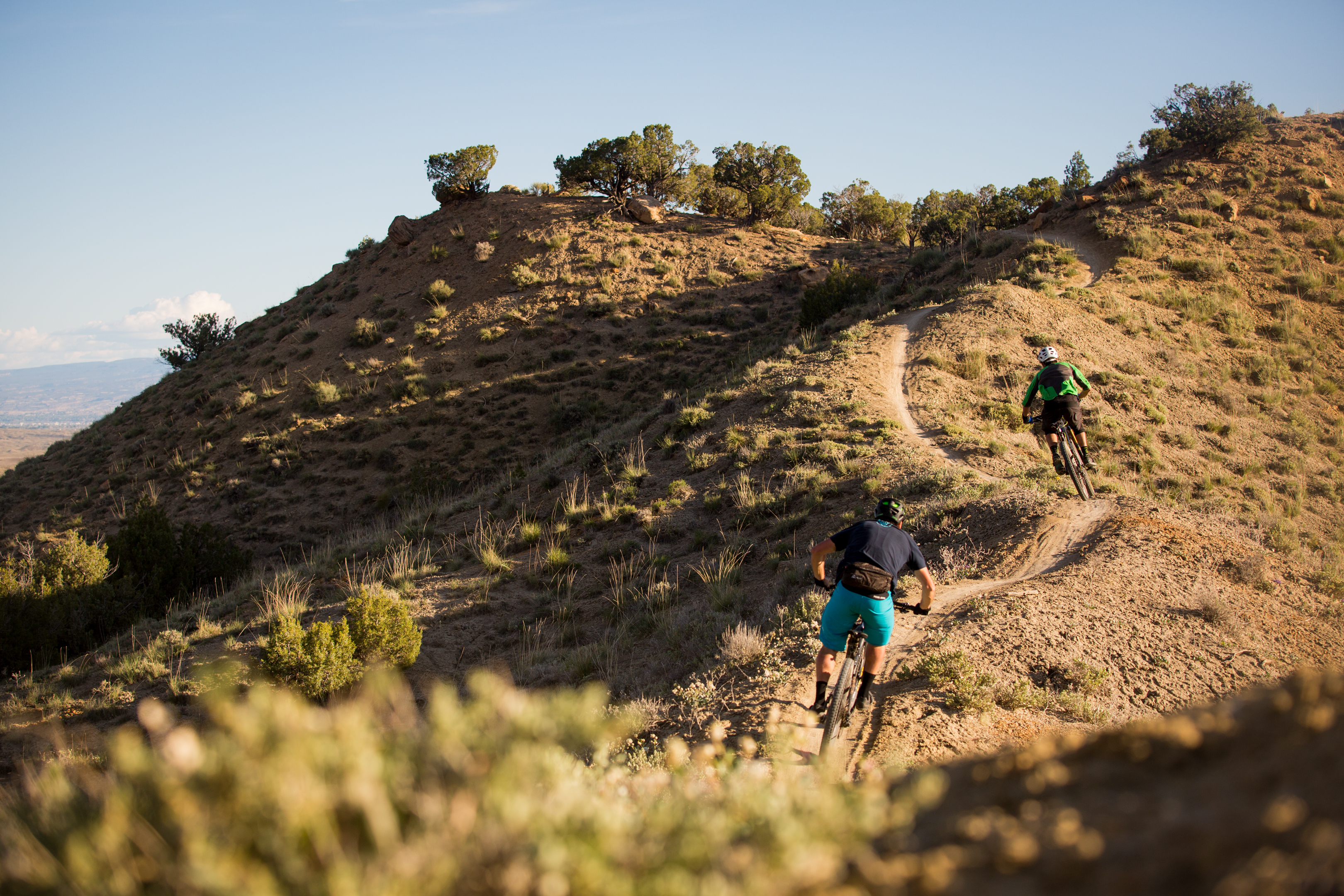
Singletrack is generally defined as a trail being narrow enough that users must generally travel in single file. While the non-mountain biker may not understand mountain bicyclists desire for access to singletrack, the reasons are the same as for other user groups narrow trails provide a more pure and enjoyable outdoor experience. While the individual experience obviously varies, mountain bikers seek out narrow trails for much the same reasons as other users: solitude, a more interesting trail, physical challenge, beauty, and a feeling of being more in touch with nature. Mountain bikers choose to ride their bicycles on dirt instead of pavement for the same plethora of intangible reasons hikers choose to walk on trails instead of city sidewalks.
Neighboring Singletrack Opportunities
East Bay mountain bikers looking for singletrack riding must, with the exception of Joaquin Miller Park, now travel to neighboring counties in order to enjoy the singletrack experience. Every weekend hundreds of East Bay cyclists load up their cars and drive to Marin to ride their bikes in Camp Tamarancho Boy Scout Camp where mountain bicycles are actually restricted to singletrack. Others ride China Camp State Park. Many more flock to El Corte De Madera Open Space Preserve in the Mid-Peninsula Open Space District, Annadel State Park in Sonoma County, Wilder Ranch State Park in Santa Cruz, Henry Coe State Park outside of Morgan Hill, Soquel Demonstration Forest in the Santa Cruz Mountains, and Rockville Park in Fairfield.
What is so unfortunate is that many of these cyclists could easily ride their bikes from their front door to East Bay singletrack if only they were permitted to access it. All of these land managers have recognized the importance of mountain biking in the area surrounding its birthplace of Marin County. It is time for the EBRPD to enact policy that is in line with that of the surrounding communities.
Safety
Safety concerns are often cited as a reason to restrict mountain bikes from singletrack. While there are anecdotal reports of collisions and near misses between cyclists and other users, we have seen no documented reports of these incidents.
The nature of singletrack trails actually requires mountain bikes to travel more slowly. In fact, it is part of their allure slow speeds feel very fast on a narrow, flowing trail. While a long fire road downhill can provide a cyclists with the gravity fed power that enables he or she to reach high speeds with relative ease, singletrack trails present frequent changes in contour and direction that require a cyclist to maintain lower speeds, even when going downhill.
By opening singletrack trails to bicycles, the District can actually ease the congestion on some of the more heavily used fire roads. These roads tend to be very popular among many users and can be a prime location for user conflict. It is where different user groups most often encounter each other. By opening some singletrack trails, the District could actually address safety and user conflict concerns by routing traffic on to some lesser-used trails.
The very fact that cyclists ride singletrack trails in all of the parks listed above, everyday, without reported incidents shows that shared use on singletrack works.
Cyclists as a Part of the Trails Community
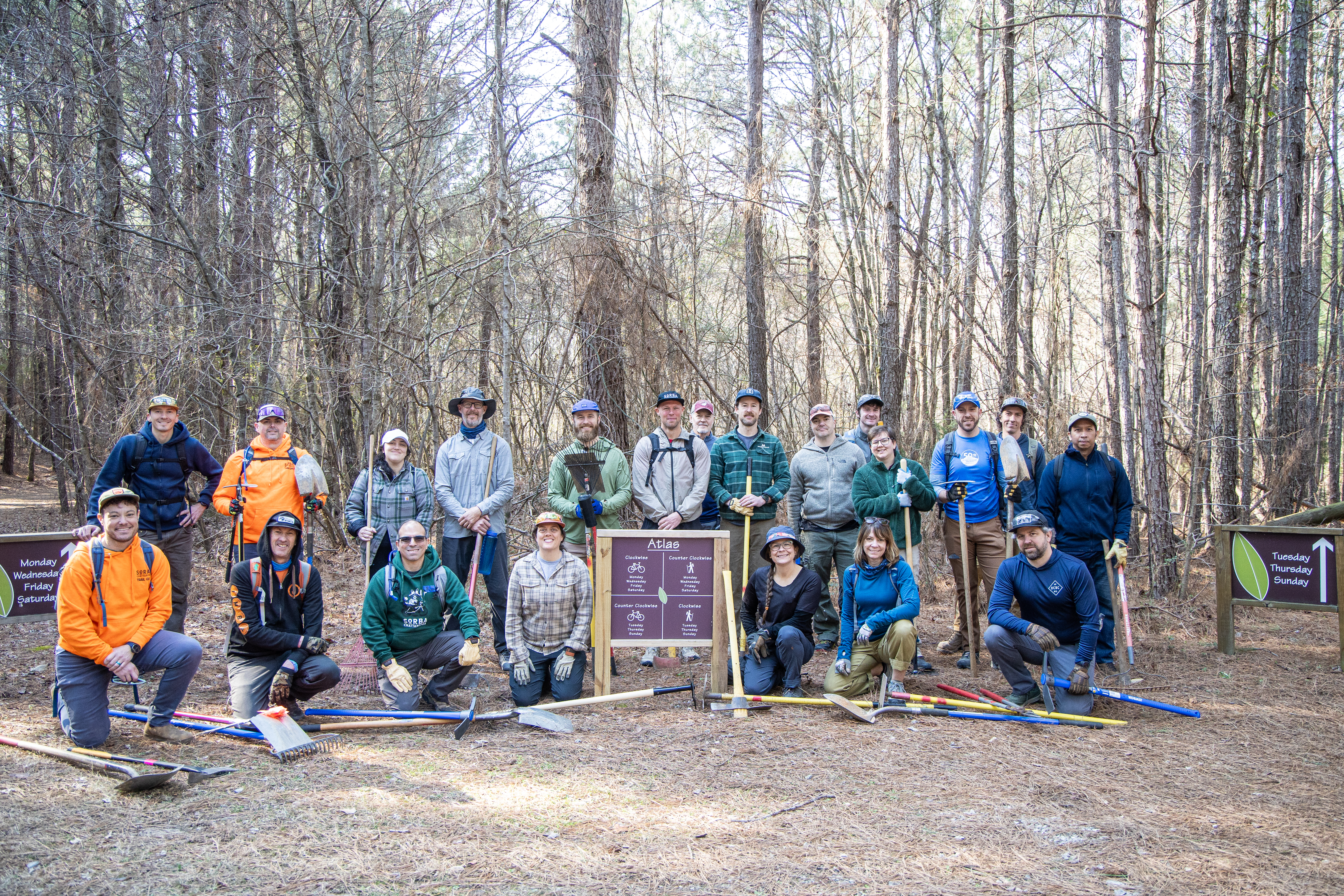
Bicyclists have shown themselves to be one of the most active and involved user groups in public open spaces. In park districts where bicyclists are welcomed, we have shown a strong history of public service and stewardship of those lands. Examples are trail maintenance, volunteer bike patrols, introductory skills and etiquette clinics, and outreach to the trail community in general at trailhead information stations.
If appropriate access is granted in EBRPD, the Districts experience will be one of great support from the cycling community. We already have some of these programs in place within the District imagine the support we will provide when our sport is accepted and embraced.
The mountain bike patrols will likely increase, assisting and educating all park users. Our trail maintenance focuses on the trails on which we are permitted to ride. While we could certainly assist with maintenance on fire roads, they are easily and routinely maintained with heavy equipment. Singletrack trails are more appropriately maintained with hand tools, and so that is where we put our effort, sometimes on Sinbad Trail in Pleasanton Ridge, and often in Oaklands Joaquin Miller Park.
Involvement in mountain bike related community service is on the rise in the Bay Area. In order for the District to receive this support it must accept the user group that would provide it.
Erosion
Fire roads are much more prone to erosion than singletracks. This is why the District must annually grade its fire roads, while most singletracks stay in good condition, relative to the adequacy of their design. Regardless, the chief erosion factor on any trail system anywhere is water. This has been most recently illustrated in an environmental study of Oaklands Joaquin Miller Park. The study basically shows that, erosion from recreation is roughly the same across all users. It also says that the vast majority of erosion that occurs in Joaquin Miller Park is caused by water. This study is available on the BTCEBs website at www.btceb.org.
Alternatives
Several alternatives are available to the District to address cyclists needs and concerns quickly.
Alternative 1: Bikes would be allowed on most narrow trails and currently closed fire roads by default, but park supervisors would have discretion to keep particular trails and roads closed or open with restrictions. On narrow trails the speed limit would be 10 m.p.h., walking speed on turns.
This is the most favorable alternative to cyclists and the one supported by over one thousand people who signed the attached petition. While the BTCEB fully supports an "open unless closed" rule regarding bicycles on singletrack trails, we recognize that the likelihood for public acceptance of this alternative is narrow.
Alternative 2: Adopt a more expeditious means of implementing a revised version of the current Trail Checklist. The BTCEB proposes that the District consider:
- Open specific trails to bicycles for a trial period these trails should be opened as soon as possible. It has taken far too long to make any decisions regarding trail access and we need to move forward.
- Revise the checklist to make the questions more pertinent to shared use a date must be set for the checklist to be completed. It would need to be complete and approved by the public by the time the trial period in item 1 is complete.
- Evaluate the trails with the revised checklist at the end of the trial period.
- Determine which trails should remain open to cyclists on a permanent basis immediately at the end of the trial period.
A formal method of evaluating trails for bicycle use is necessary. However, it is not practical to make such evaluations without seeing how bicyclists and other users actually interact on a given trail. A trial program would address this issue.
Alternative 3: Continue to work toward completing the trail checklist and implement it as originally intended.
The BTCEB was involved with the East Bay Area Trails Council during its development of the Checklist, formerly known as the Bicycle Matrix. While it initially appeared to have great potential, the checklist has taken far too long to develop, its criteria are too vague, its implementation is too complex and, many of the trail using public do not feel that it is a good tool. The BTCEBs comments to the Checklist are included as Appendix B.
Recommendation
The BTCEB proposes that the District adopt Alternative 2.
A more expeditious and relevant process is needed. While the Checklist provides for a means to evaluate trails for appropriate use, it remains in a draft stage and much work remains before the trail using public will find it acceptable. Its criteria are far too vague and subjective. Many of the questions are irrelevant or difficult to answer without actually subjecting the trail to shared use. The BTCEBs comments and proposed changes to the Checklist are attached. Further, should a trail be determined appropriate for shared use, under the proposed process flow, any change will take far too long to implement. A more efficient means of evaluation is needed.
It should be noted that bicyclists are not requesting access to every singletrack trail in EBRPD, nor are we asking for restrictions on other types of use on trails that allow mountain bikes. Rather, we are requesting access to a specific set of trails, which we expect to share with other users. Many singletrack trails would not be accessible to bikes under our proposal and could be used by park visitors wishing to recreate in areas without bicycles. In fact, we are only requesting access to 27.5 miles of singletrack out of over 200 miles of singletrack in the East Bay Regional Parks District, or less than 15%. Cyclists would be sharing these with hikers and equestrians, while the remaining trails would be accessible to these other users without bicycles. This is a very reasonable request.
With regards to the specific trails that we would like to see opened on a trial basis, they are listed in the table below. Of course, if the trial periods on these trails prove successful, it will be our expectation that they be opened to bicycles permanently. We propose that the trial basis be at least 90 days long and start as soon as is practically possible. If the Checklist is not complete and approved by the Board at the end of the 90-day trial period, the trails should remain open until the Checklist is complete and approved.
Proposed Trails for 90 Day Trial Evaluation
|
Park |
Trail |
Length |
|
Tilden |
Volmer Peak Trail |
0.5 |
|
Redwood |
Crown Trail Orchard Trail |
1.2 0.6 |
|
Anthony Chabot |
Brandon Trail between Ten Hills and Willow Gate Columbine Cascade Willow View |
<1 2.9 1 0.5 |
|
Mission Peak |
Ohlone |
3.6 |
|
Garin |
Pioneer Garin Woods Zeile Creek |
1.2 0.6 0.5 |
|
Sunol |
Ohlone Indian Joe Creek McCorkle |
0.3 1.2 1 |
|
Las Trampas |
Las Trampas Ridge Virgil Williams Trail |
Uncertain combined with fire roads, for 10 mile loop in little used park. |
|
Pleasanton Ridge |
Woodland Trail |
0.9 |
|
Del Valle |
Badger Cove, Loop Trail East Shore Trail |
4 (possibly one trail) |
|
Total |
Approximately 27.5 |
The BTCEB recognizes the likely reluctance of the District to simply open to bicycles a list of trails that we request, even on a trial basis. We would propose that an informal evaluation, including a field visit to the trail by relevant District Staff and Board, along with selected members of the cycling community and other user groups, be conducted to determine if these trails are suitable for bicycle use on a trial basis.
Conclusions
While the District has been working to come up with an appropriate way to manage the increased visitation in its parks due to the growing Bay Area population and the increasing popularity of outdoor sports, it has not met the needs of many park users. User conflict has gone down but does remain a problem. Meanwhile, cyclists are driving an hour or more every weekend to enjoy trails very similar to those in their neighborhoods to which they are denied access.
Of course, any change will upset some users (we dont expect that non-bikers will be pleased about their favorite trail being open to cyclists), the bottom line is that we do live in a very populated region and the East Bay Regional Parks serve as an escape from the hustle and bustle of our congested cities and freeways. These parks should serve as an escape for all citizens of the East Bay, not just a select few.
The cycling community has waited patiently and worked with the District for four years and no new access has been granted. A new singletrack access policy for bicycles is needed and it is needed now. The BTCEB supports a very aggressive trail opening policy as defined in the petition. We support it and we believe that it would work. We also recognize that it is too much too soon for many people and that an evaluation process needs to be conducted before trails will be opened to bicycles on a permanent basis. Therefore, we have proposed an alternative that seeks to open approximately 10% of the Districts singletracks to bicycles on a ninety-day trial basis during which the Checklist will be finalized. This proposal will address the concerns of cyclists quickly, set a timeline for completion of the Trails Checklist, and provide for a means of trail evaluation for shared use.
Appendix A
Petition
Appendix B
Checklist Comments