IMBA - International Mountain Bicycling Association
What would we do without trails?

Chapter 6: Wilderness Stakeholders

Bicycling and Wilderness: A Mountain Biker's Guide to Wilderness Advocacy

A majority of the American people supports existing and additional Wilderness designations and most bicyclists share these feelings. Unfortunately, you will likely find that most people do not know that Wilderness bans bicycles. For this reason, it is imperative to reach out to as many stakeholders as possible and let them know that while you may agree with the idea of Wilderness, the ban on bicycles necessitates your involvement in negotiations before supporting a Wilderness bill.

But Americans' views towards Wilderness are anything but easily defined. In any Wilderness campaign there are likely to be numerous groups in favor or against the proposal. Some of these groups may be in favor of Wilderness in one campaign but against it in another. It is therefore impossible to nail down a consistent stance from many groups and describing groups' positions requires very broad generalizations that may not always be true. Nonetheless, in examining Wilderness campaigns some trends do appear.

IMBA's Wilderness Position:

IMBA supports the principles of preservation. You may want to read this essay on the mountain biker's environmental ethic written by Jim Hasenauer, a former IMBA board member.

In addition, a short summary of conservation actions by mountain bike advocates can be found here.

IMBA stands by these guidelines:

  • Wild areas should remain free of roads and structures.
  • Wild areas should be protected from development.

This ethic puts us squarely in line with many of the mainstream environmental groups. However, bicycle-banning interpretations have put us in a difficult spot. As a rule, IMBA suggests that bicycle advocates should not simply oppose Wilderness preservation efforts. We suggest you work towards a solution that protects both the land and trail access. Often, suitable designations exist to help preserve the environment and the recreation resources we value.
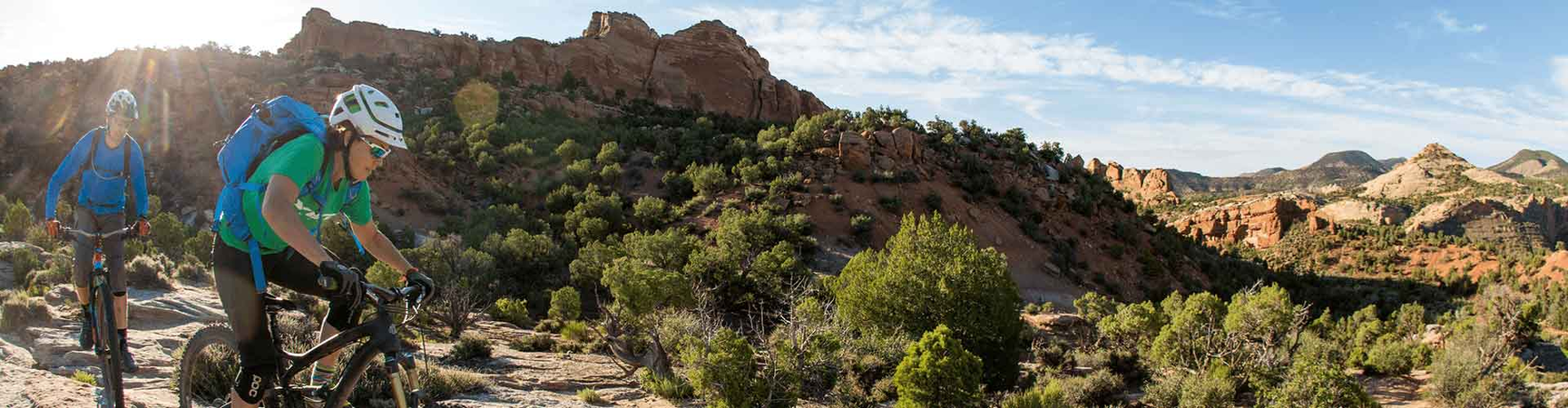
Mountain bikers, like many hikers, generally prefer riding in pristine forests to clearcuts, narrow trails to jeep roads and primitive areas to developed areas. To help preserve this experience, IMBA has advocated consistently in support of conservation and preservation.

In 1995, IMBA joined two dozen environmental groups in endorsing and publicizing the Environmental Bill of Rights, which urged the 104th Congress to maintain and strengthen environmental protection in the United States. IMBA clubs have participated in numerous campaigns to raise funds to acquire open space lands near municipalities. IMBA has long supported efforts to revitalize the Land and Water Conservation Fund, which buys lands for conservation and recreation purposes. In 1998, IMBA reiterated its support for Utah Wilderness and maintained, "Bicyclists must be at the table when Wilderness decisions are being made."

Further, IMBA is a strong supporter of environmental education, especially in the design and restoration of environmentally sound singletrack, partnering with thousands of land managers and volunteers to promote sustainable trail building techniques.

IMBA maintains that bicycles are compatible with the spirit of wilderness. During negotiations with the Sierra Club in 1994, IMBA asserted our right to advocate for trail access in the future. In our 1998 statement on Utah Wilderness, we stated:

IMBA is not advocating the introduction of mountain bikes in existing designated Wilderness areas. However, IMBA believes that bicyclists are appropriate, muscle-powered trail users that are compatible with the philosophy of the 1964 Wilderness Act and the intent of Congress to exclude motorized "mechanized transport" from Wilderness areas. In 1984, the definition of 'mechanized transport' was extended to mountain bikes without adequate data, experience or input.

Other Groups' Wilderness Positions:

Rural populations have occasionally spoken out against Wilderness. This could be for several reasons, including economic reliance on natural resources or other restrictions Wilderness brings to public lands. For obvious reasons, motorized recreation groups often, but not always, oppose Wilderness. Sometimes, however, when a proposed Wilderness area is of little value to their recreation activities, these groups will adopt a neutral or favorable position.

Local governments might go either way. Some are concerned with the loss of natural resource extraction opportunities while others may see Wilderness as a tourism boost.

In the political arena, we usually see Democrats in favor of Wilderness, while Republicans are more cautious in lending their support.

Lastly, environmental or hiking groups are almost always in favor of Wilderness bills. Equestrian groups fall on both sides of the issue, with some favoring expanded Wilderness protection while others oppose Wilderness due to worries over trail maintenance.

Remember, these summaries are a very broadly generalized. It is impossible to pigeonhole a single user group without talking to them first. You should always treat Wilderness on a case-by-case basis.

Email this page Printable Version

Help | Site Map | Copyright
IMBA Homepage Join IMBA Now!