Unauthorized Trails - Do They Threaten Our Sport?
Freedom. This word captures the spirit of mountain biking. Mountain biking calls to the self-sufficient individual looking to explore the endless wooded trail, to push their physical and mental boundaries and to escape - however briefly - the standard routine of life in the 21st century. This search for freedom, however, has taken a side path that threatens the future of our sport: the construction of unauthorized trails.
Throughout history, new trails have been created where people or animals needed a way to get from one place to another. Today, however, the parameters of trailbuilding are more complicated: the earth's population is mushrooming and millions of acres of land are developed each year. Our remaining public lands have become treasured resources that require careful management. Government agencies have a responsibility to administer public lands to meet a wide range of needs. Trails created without permission compromise the land manager's ability to meet these needs.
Some mountain bikers build unauthorized trails and stunts because they seek more challenging terrain to match their improving skills and technology. Others are motivated by a desire to satisfy the need for viable connector routes linking trail systems. Popular mountain biking films and magazines have glorified clandestine paths. Regardless of the rationale, IMBA absolutely does not support building unauthorized trails.
All the work that IMBA and our 400 affiliated clubs do to improve mountain bike trail access involves cooperative work with the people who manage the land. Gaining legal trail access can be a complex and time-consuming process, but it has paid great dividends for mountain bikers. Trail access for cyclists is almost universally better now than it was 10 years ago, and this is directly related to solid relations between mountain bikers and land managers. Government officials now look to mountain bikers for solutions to improving trails, while balancing increased population pressures and environmental concerns.
The construction of unauthorized trails undermines this process - not only because it defies the spirit of cooperation but also poses environmental uncertainties. Most trails are planned and built as part of a master plan that considers multiple factors. Unauthorized trails - while often carefully built - may threaten habitat, plants and trees and increase erosion. Renegade trails hurt the vast majority of mountain bikers who have never even considered building an unauthorized trail.
With increasing frequency, IMBA receives calls from concerned land managers who discover unauthorized trails in their area. Already, a few popular trail networks have been closed to mountain bikers because land managers didn't have resources to curtail the construction of unauthorized trails. This is unfortunate: IMBA, as always, is determined to keep public trails open by finding other solutions.
In this edition of IMBA Trail News we take a look at unauthorized trails from a number of perspectives. The goal of this presentation is not to glorify or chastise unauthorized trailbuilding. Rather, we hope to offer solutions to mountain bikers and land managers. We want to help build technical, challenging trails, where appropriate. We want to encourage the construction of logical trail connectors. The future of our sport will continue to depend on a spirit of trust and cooperation that cyclists and trailbuilders develop with land managers.
Unauthorized Trails - IMBA's Position & Solutions
Position:
- The future of mountain biking depends on cooperation with land managers.
- IMBA opposes building or altering trails or structures without land manager permission.
- Unauthorized trailbuilding may produce unwanted environmental consequences.
- Do not ride on trails that are closed to bikes.
- Don't ride off trail.
Solutions:
- Mountain bikers and land managers should cooperate to find solutions that work for everyone.
- When possible, trail networks should accommodate a wide range of user groups and ability levels. There should be trail opportunities for beginning, intermediate and expert visitors.
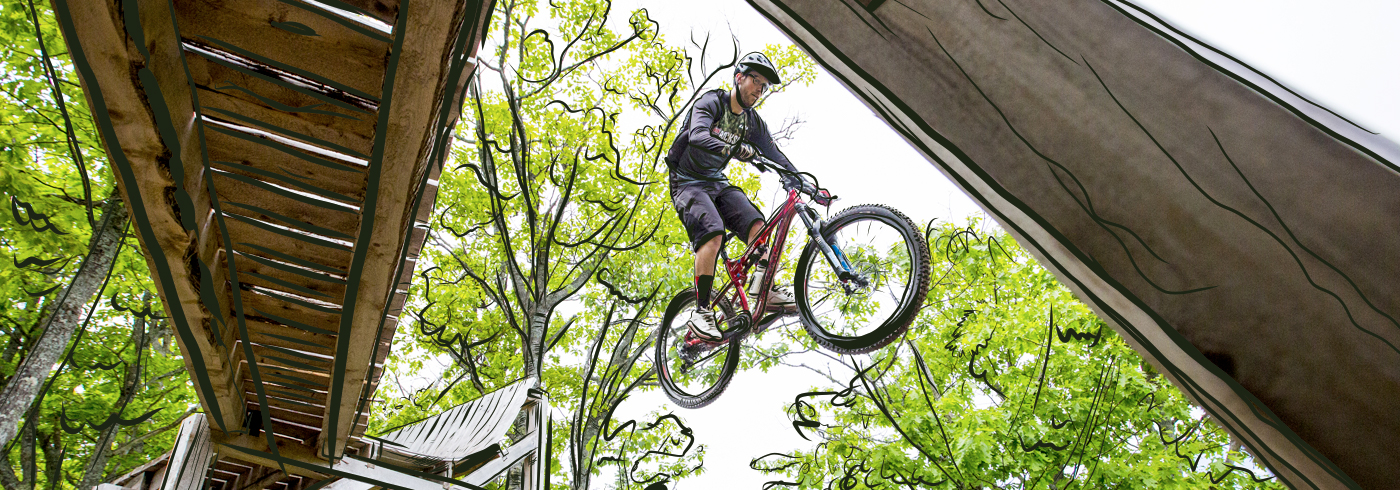
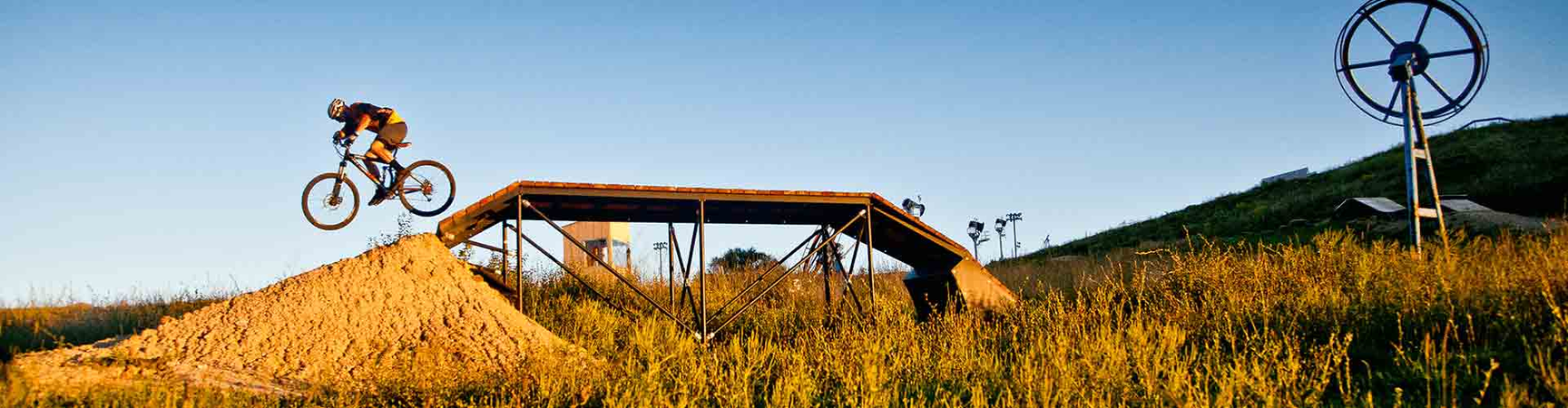
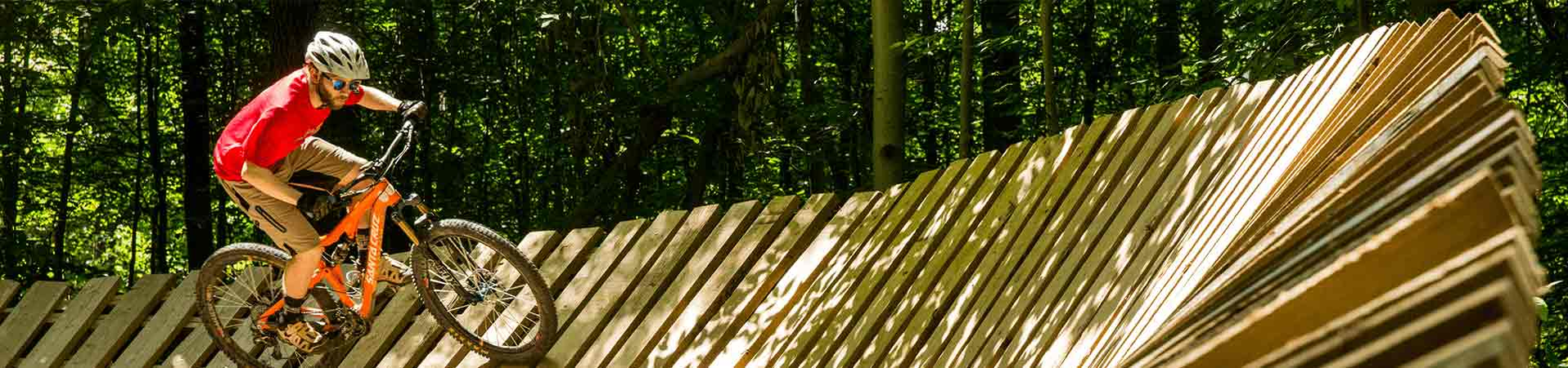
- IMBA is very concerned by the recent trail construction trend of elevated, man-made stunts. IMBA accepts use of man-made stunts only when land manager permission is granted or in special use areas. IMBA continues to support the concept that most trails should be natural surface.
- IMBA supports the development of technical trails using natural terrain and features.
- IMBA supports the use of signs to alert visitors about difficult sections of trail.
- IMBA supports stunt parks and special use technical riding areas where land manager permission is granted.
Unauthorized Trails - The Trail Care Crew's Perspective
We asked Joey Klein and Nichole Williams of IMBA's well-traveled Subaru/IMBA Trail Care Crew for their perspective.
Do you guys encounter unauthorized trails in your travels?
Yes. We see unauthorized trails everywhere. Any park or forest that attracts
people will have social trails.
Why are unauthorized trails built?
There are many reasons. It can be as simple as walkers just wanting to get from
their backyards to an interesting natural feature in an open space, or as complex
as miles of constructed "stunts" high off the ground in a dense Canadian rain
forest. Often, trail visitors are looking for something more challenging.
What about downhill and elevated-stunt trails?
Downhill or stunt trails can be quite extreme and realistically can't be
considered multi-use trails. Because downhilling and stunt riding are
fast-evolving disciplines, the trails that these mountain bikers desire come as a
shock to most other visitors and land managers. Liability and erosion are also a
concern on these trails.
What are some solutions to unauthorized trails?
Mountain bikers and land managers should work together to determine who the users
are and what needs should be met. This way trails can be designed that are
sustainable and appealing to everyone.
Give us a real-world example of an innovative solution.
In Park City, Utah, a local "renegade" trail builder had an amazing passion for
trails, but everything he built was unauthorized. The local landowners hired him,
hoping to channel his energy into trails everyone could enjoy. He went to several
technical trailbuilding clinics, including an IMBA Trailbuilding School. Now his
energy has been harnessed and everyone can enjoy his fantastic trails. We have
examples similar to this in almost every place we work.
Any other thought on unauthorized trailbuilding?
When mountain bikers build trails without permission, it hurts the sport's
credibility. "Renegade" trailbuilders need to come forward and work with land
managers
Unauthorized Trails - What Land Managers Say
In IMBA's 13-year history one truth about mountain bike access has been confirmed time and time again: The best way to keep existing trails open and to develop new trails is to establish and mainatin respectful and professional cooperation with land managers.
An increase in unauthorized trailbuilding by mountain bikers could threaten these partnerships. While land managers we talked with acknowledged problems with unauthorized trails, they stopped short of condemning all mountain bikers. They recognize renegade trails as the work of a minority and still have respect for our sport as a whole, especially where local mountain biking groups have a history of volunteerism and cooperation. Here is what two land managers said:
Steve Gammon, Wompatuck State Park, Hingham, MA.
"We've had some renegade trails in the park. The growth of mountain biking was putting a lot of pressure on our trail system - things were getting out of hand. If it were not for the local mountain biking group (NEMBA), we might have closed trails. Instead, NEMBA convinced us to add new routes and spread things out. We now have plenty of trails for everyone, including some challenging trails towards the back of the park that have been well received."
Kim Frederick, Jefferson County Open Space, Golden, CO.
"There are a couple illegally built trails in our system. In one case it was primarily downhill mountain bike riders who were involved. There is no question in my mind that downhill mountain biking is a valid form of recreation but where it should occur is another thing. It is impossible for everyone's recreation needs to be met at all locations all the time. There have to be some compromises. Folks need to be patient and work within the system. A solid professional relationship between mountain bikers and land managers is the key to getting new trails."
Unauthorized Trails - The Playground Success Story
Downhill, slalom and stunt riding are becoming increasingly popular forms of mountain biking. However, the suitability of these activities for traditional multi-use trails is a source of concern for land managers and other trail visitors. Because of the high speeds and challenging trail features that these trail activities embrace, riders are seeking specific-use areas where they can practice their skills and avoid conflict with other trail users. One of the best examples of this new breed of specific use areas is The Playground, located in Simi Valley, California.
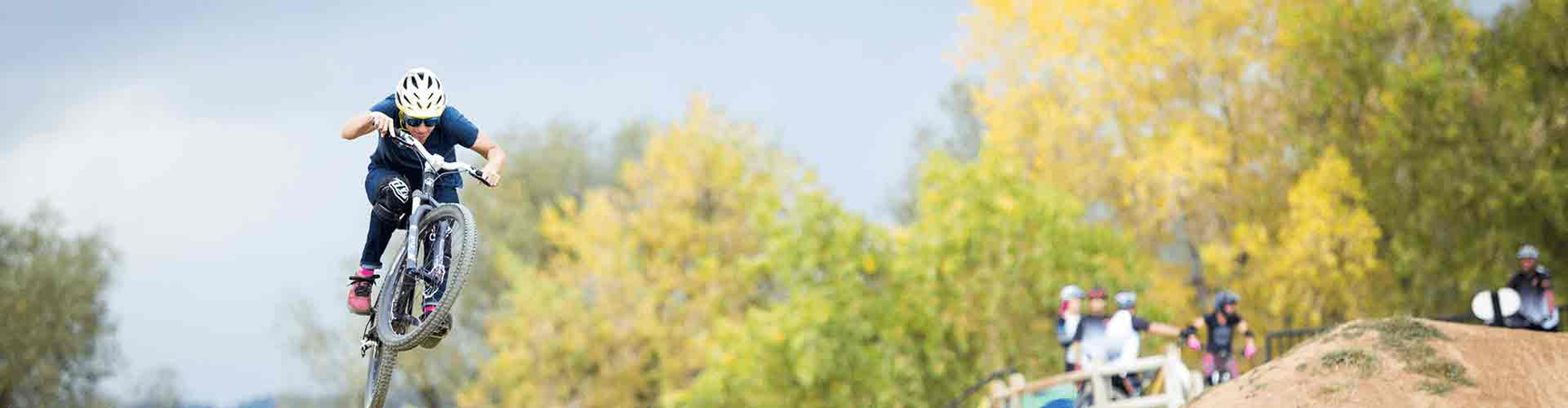
Sited on an unused agricultural plot of less than ten acres, The Playground offers jumps, banked turns and drop-offs to advanced mountain bikers. The course, which drops 300 feet in elevation, takes the fastest pro rider about a minute and 15 seconds to descend. Similar to skateboard parks that dot towns across the U.S., The Playground gives young riders a safe place to practice their skills. As many as 70 riders visit the area every Saturday.
The Playground was built with volunteer and paid labor over an 11-month period. The land is rented from a private landowner and insured for a minimal monthly cost.
Currently, The Playground is open only on Saturdays. In the future, the managers hope to open the area a few days a week. Each visiting rider is asked to make a $12 donation and sign a waiver.
Recognizing the value of The Playground and the possibility of replicating it elsewhere, Azonic, Marzocchi and wheelworld.com have decided to support the area.
Every community in North America has riders who would appreciate this kind of course," says The Playground's manager Mark Avery. "Our style of riding is new, but it is a growing and legitimate form of recreation. The Playground gives these riders a place to do their thing and avoid conflict with public land managers or other trail visitors."
For more info contact or www.mtbplayground.com