Trail Diplomacy: The Simple Path to Mountain Biking's Future
IMBA's website contains more than 800 pages of helpful information relating to trail design, construction, maintenance and management. Visitors to imba.com also find great advice on sustaining volunteer groups and working with government officials.
But since IMBA's goal is to assure a bright future for mountain biking, perhaps our website would be equally effective if it included nothing more than hundreds of consecutive pages on which the following words appeared in huge type:
BE NICE TO THE PEOPLE YOU MEET ON THE TRAIL.
We're kidding...but not really. What happens when we meet and pass people - especially hikers and horse riders - is the most important factor in shaping trail access.
While most trail users around the country say they're satisfied with their experiences on shared trails, some say they've been scared by close encounters with mountain bikers and are reluctant to walk on trails that are heavily used by cyclists. (Of course, the reverse is true: mountain bikers shy from paths packed with walkers because it's hard to find a rhythm and roll smoothly.)
These concerns are real and must be addressed--though not by closing trails to mountain bikers, except as a last resort. Thankfully, there are dozens of ways to reduce trail-user conflict that are less severe.
Nevertheless, we believe that conflict between different types of trail users is the root of most trail closures. Most concerns about erosion--which is the other main category of complaints about mountain biking--can be addressed by proper trail design and regular trail maintenance.
Thankfully, interaction on the trail is one element of our sport that we have the power to control. If all of us (realistically, most of us) can improve the way we pass hikers and equestrians, land managers will hear fewer complaints. Fewer complaint will mean fewer trail closures. It's that simple.
Interpreting the Rules
IMBA's globally recognized Rules of the Trail include the concept "Yield the Trail." Yielding, by IMBA's definition, means "slow down, communicate with the people you meet, be prepared to stop, and pass safely."
Let's look briefly at each of these elements. If you're riding eight miles an hour and a hiker is walking two miles an hour, it's easy to to understand why the walker may be intimidated by your approach at speed. If you're riding 15 miles an hour and you slow to eight, you'll feel like you've slowed dramatically, but the hiker may still see you as a fast-moving threat. That's why slowing a little more than what seems natural is an important element of a well-executed pass.
Communicating on the trail is an art, particularly when you are approaching hikers or equestrians from behind. They're savoring the quiet of the woods just as you are. Do you shout, "Hi?" Do you strike a bell? Do you flick a brake lever? There's no set rule, but there clearly is a difference between a deftly announced approach and a last second "On your left!" Timing, volume and tone are everything.
Be prepared to stop. There's no question that if every mountain biker stopped, dismounted and stood at the side of the trail every time we met a hiker or equestrian that trail-user conflict would be reduced - in fact, nearly eliminated. But another consequence would be an end to mountain biking as we know it.
Many of us would quit the sport, particularly those of us who live near big cities and have no choice but to ride on crowded trails. An occasional dismount is reasonable, but if we have to stop every 20 seconds and get off our bikes, we'll quickly search for other, less-crowded trails. And if we can't find any, we'll buy a season pass at the community swimming pool. If mountain biking isn't fun, why bother?
IMBA believes strongly in shared-use trail systems. But if paths are so jammed that no one--hikers, mountain bikers or equestrians--can relax and get into the flow, separate routes are a better option than severely restricted access. In crowded cities, single-use trails are a viable solution.
Here's the reality of a typical on-the-trail passing situation: two or three mountain bikers approach two hikers, the mountain bikers say "hi," the hikers step gracefully to the side, and the mountain bikers roll smoothly through...and everyone is basically content. The yield came when the mountain bikers slowed down, looked at the hikers, said "hi" and read the situation to decide if dismounts were necessary. In most cases, they're not...but in a few--particularly when meeting horses--they are essential.
If mountain bikers truly and completely yielded to hikers, we'd follow them home, trailing just behind. The reality is that the pass must occur.
Privately, many mountain bikers wish the rules of the trail could be rewritten to read "hikers yield to mountain bikers." After all, it's so easy for hikers to step aside and it's more difficult for us to brake, slow way down clip, fully out of our pedals, dismount and stop. This would be a practical change and a more accurate reflection of what really happens out on the trail.
The problem of such a switch is its symbolic message. Walking remains the simplest trail activity. It is quiet, generally (though not always) has the lowest impact, and is available to all able-bodied people. Its tradition began when the first monkey stood upright--several years before Gary Fisher was born. Walkers were on the trail first...and in our system of values, that matters.
Yielding protocol is also designed to promote safety. In an abrupt meeting between cyclist and hiker, the foot traveler is more vulnerable. In any trail gathering, the person sitting six feet off the ground atop a horse has a long way to fall if the pass doesn't go well.
Respect remains important. Anything we can do to make sure our fellow trail visitors have good experiences is going to help us in the end. If we can find ways to do this without taking much away from our own experiences, so much the better. This is the challenge.
Relations on the trail remain key to the future of mountain biking. That's why IMBA is pleased to present this special section filled with ideas on ways we can reduce our impact on others and on the land.
Riding with respect for the land is relatively straightforward. Volunteering for trailwork is a no-brainer. Supporting your local land manager: who wouldn't, so long as they're supporting mountain biking?
It's the meeting and greeting part of our sport that requires more attention. Think about it, then read what we have to say on the following page.
The Trail Care Crew's Perspective
We asked well traveled Subaru/IMBA Trail Care Crew leader Joey Klein for his perspective on how trail design can ensure that we all get along.
Where have you seen good trail design help minimizing user conflict?
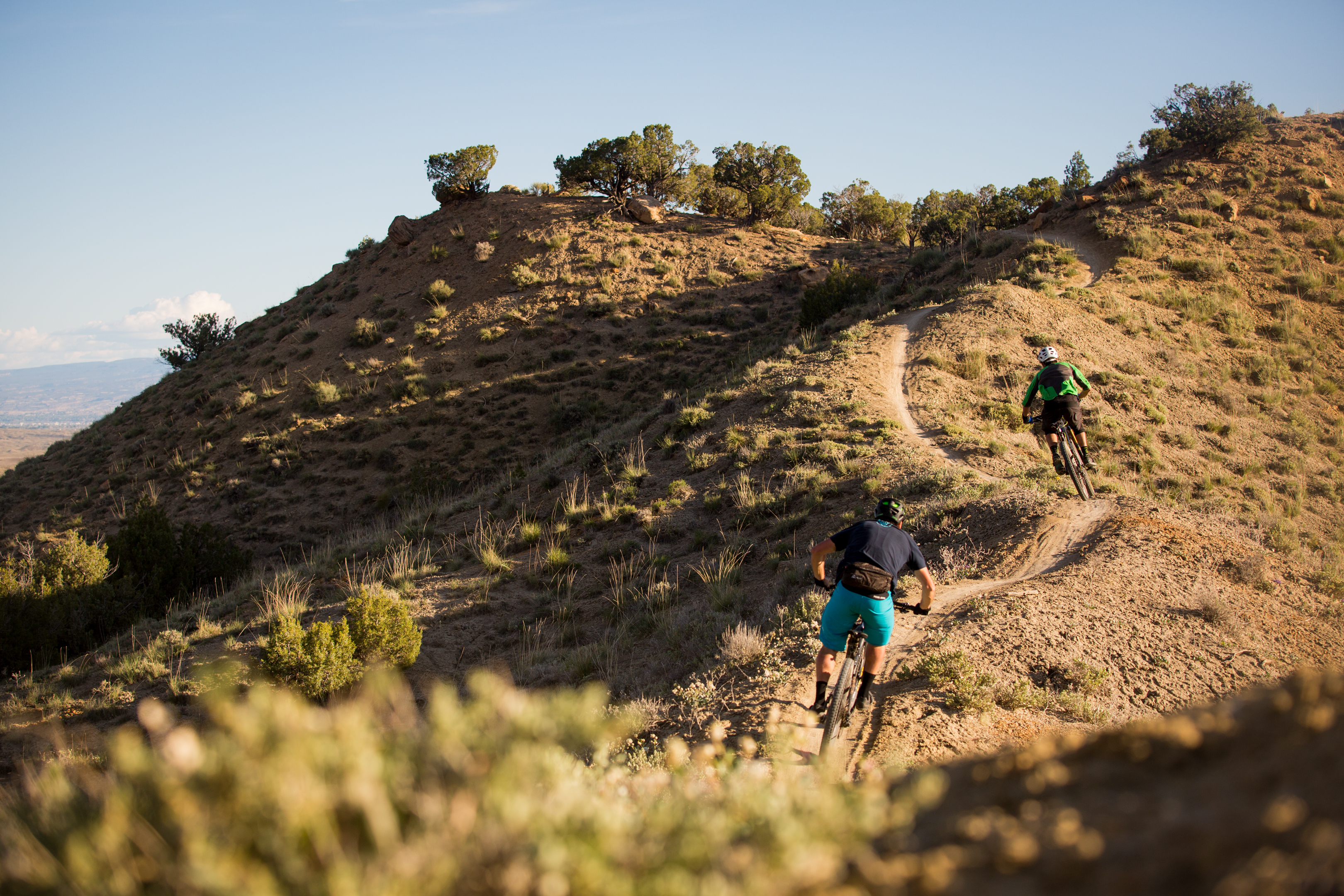
The Buffalo Park and Elden Mountain trail system in Flagstaff, Arizona, are great examples of trail systems that minimize trail conflict. Both are minutes from downtown Flagstaff, but because of their high-quality construction, user conflict is minimal. The trails starting from the parking lot are wide and free flowing with long sight lines. The first few miles of trail on any system are always the most heavily used, so wider pathways that allow amply passing room are desirable. After a few miles, trail users at Buffalo Park have the choice to head for the more challenging trails up to Elden Mountain. These trails are twisty, rocky and narrow but still have long sight lines. Technical trails slow mountain bikers and provide highly desirable challenge. Buffalo Park and Elden Mountain combine slow, technical trails with flowing, open trails and great sight lines to almost eliminate user conflict.
What role can trail layout play in reducing user conflict?
Proper trail design can mitigate any user conflict. The best trail systems provide shared use opportunities for a range of ability levels. The design of a trail dictates how trail users experience that space. Long, smooth, straight stretches of trail are great for beginners but will encourage speed. Twisty, rough and technical sections give advanced riders challenge while keeping speed down. A good trail system has a mixture of "open and flowing" and "tight and technical" trails. Also, in areas with large population bases, single or double use trails can be the best solution.
What are some specific techniques that can help minimize user conflict?
Trails that are too fast can be altered by texturing the tread or bringing obstacles in to make the tread more twisty. Heavily used trails should be wide, but rough and twisty to slow people. Good sight lines are key; if vegetation and obstacles are waist high it keeps users on the trail and allows them to scan over the top for other trail users. Trail junctions should be in open areas so people have time see each other. It's important that all trail users work with land managers to create trail solution that work for everyone.
Communication is Key
Some mountain bikers have mastered technical riding. They are able to negotiate the hairiest sections with grace and style. Other riders are masters of the downhill - launching over rocks and drops without fear. Climbing specialists can stomp their way to the top of a hill with half the effort it takes the rest of us. But more important that strong climbing, technical or downhill skill is mastering the art of the pass - being able to deftly move among hikers and equestrians with the ease of a politician, the grace of a dancer and the good will of an ambassador.
If every rider exercised proper passing etiquette, mountain bikers would be welcome almost everywhere. Land managers wouldn't bristle at the thought of opening trails to bicyclists. Hikers and equestrians would keep an open seat at the trail planning tables - inviting our participation.
The old cliché is true: you never get a second chance to make a first impression - on hikers, horseback riders, trail runners or other mountain bikers. Chances are, trail users with the strongest anti-mountain biking mentalities were probably incited by unpleasant interactions with inconsiderate mountain bikers.
Even after 25 years, mountain biking is still perceived as one of the newest sports on the trail. It's important that we work to counter the negative and false image that mountain bikers are out-of-control and insensitive. The trick is to find a balance between respecting other trail users and enjoying our off-road riding experience.
The elements of a perfectly executed pass include slowing down, being prepared to yield the trail, communicating a plan and passing safely.
Every time we pass another trail user, we have the power to make it a positive experience. It is the single greatest thing we can do for the future access of our sport.
Low Impact Riding Techniques for the X(TR) Generation
It used to be that newbies were lowest on the mountain biking totem pole. Beginners or "freds" didn't get much respect. Times have changed. Nowadays the least respected riders are the ones who threaten our future trail access with their bad behavior. Follow these IMBA soft riding tips and you'll not only avoid the wrath of your fellow riders, you'll help keep trails open for mountain biking.
Respect. It's all about respect. Treat the trail like the valuable treasure that it is. Same goes for other trail users - respect them and they'll return the favor.
Ride softly. Dirt holds a special place in the heart of mountain bikers, so be kind to it. Don't skid; adjust your braking to the soil and terrain. Float over the trail. Ride like a ghost, not a bag of anvils. Pass through unnoticed and silently.
Keep trails narrow. Notice how some popular mountain bike trails grow wider every year? Make it a game to stay directly in the center of the trail at all times. Take corners carefully to avoid blowing off line. Stay off trailside plants. Ride over rocks, logs and waterbars instead of around them. Despite the popularity of recent videos showcasing extreme off-trail riding, most of us ride only on established routes and want to make sure they are around and still narrow for years to come.
Say no to mud. Riding when the trail is muddy can cause tremendous damage. Find trails in your town that are durable and drain well and ride these when it's wet. Volunteer to help your local club build tougher trails that withstand rain. Plan your pilgrimage to Moab during your local wet season. Get a road bike.
Tone down your riding outfit. Ever notice how anti-cyclists love to use the phrase "... and then this neon clad biker ran me right off the trail"? Day-Glo billboards may work at the mall, but on the trail earth tones have less impact. It also helps if you don't run people off the trail.
Be quiet! Learn how to adjust your brakes so they don't squeal. Do something about that rattling seat pack full of wrenches and chain links. Deaden chain slap with a chain stay protector. Don't hoot and holler. Exception: Get a bell and use it, but not right in a hiker's ear. Ring it once at 50 feet and then don't touch it - instead use your mouth to say hello. Don't use bells if horses are around, unless you're certain they'll react well.
Good etiquette extends to the trailhead. Keep that thumping car stereo turned down, and resist the urge to imitate the Duke boys slinging gravel as you peel out in your quest for post-ride pizza and brews.
Quick Tips: Don't ride in large groups. Don't get lost. Pick up trash. Ride busy trails during off-peak hours. Don't ride fast on popular hiking trails. (Speed good: Bozo bad.) Don't do unauthorized trailwork.