The BLM and Mountain Biking - Partners in Recreation - 1991
BLM leader Bob Moore and others are enhancing mountain bike opportunities in the nation's largest public land block.
Gary Sprung
The United States Bureau of Land Management is moving rapidly to enhance mountain bike opportunities on its enormous expanse of Western public lands. The BLM manages 270 million acres, the nation's largest public land block. It's the Public Domain, the remainder of public lands not given to private owners and not reserved for National Forests, Parks, Wildlife Refuges or military bases. The Agency has existed for less than half a century. Congress created it in 1946 by merging several older agencies in the Department of Interior. The Congress in 1976 passed the first comprehensive law governing BLM, mandating the same multiple-use approach already applied on National Forests.
Critics have derisively interpreted the agency acronym to mean "Bureau of Livestock and Mining." Whether accurate or not, that image is quickly fading. As the West increasingly turns from extractive resource consumption toward economies based on appreciations of Nature, the BLM increasingly stresses the watershed, wildlife and recreation aspects of its mission. Mountain bikes are benefiting.
I recently enjoyed a wonderful bike ride on the Colorado Trail with Bob Moore, who heads the BLM in Colorado. Meeting him in an office, viewing his agency uniform and his white hair, you might assume this bureaucrat spends too much time behind a desk and doesn't know much about cycling. You'd be wrong! Bob rode agilely, with power and grace, up a long, glacial valley and across a wide expanse of tundra. He told tales of many adventures around the Colorado mountains on foot, bicycle, and skis. On that fine August day, Bob moved one leg closer toward achievement of a big goal. He aims to ride the entire 450-mile Colorado Trail from Durango to Denver. His busy schedule prevents doing it all at once, so he takes short trips on weekends.
Moore presides over a national BLM task force which is building a mountain bike policy and promotional program. He commented that mountain bicycling "fits perfectly with BLM's concept of multiple use. It's another use that can be accommodated on BLM lands much like hiking or horsebacking or off highway vehicle use... We encourage use of the public lands in as many ways as possible, rather than discourage use. Mountain biking is one of those ways."
As with the US Forest Service, BLM policy adopts the Open, Unless Closed approach to trail use. Nearly all BLM trails remain open at this time. One notable exception is the BLM sections of the Pacific Crest Trail in California, Oregon and Washington. Moore questioned the general closure of this route to bicycles. He serves on the board of directors of the Colorado Trail, which is generally open to bikes, except in two wilderness sections.
BLM's first got into the mountain bike business in 1988 with the creation of Kokopelli's Trail, a 128-mile route from Grand Junction, CO, to Moab, UT. In that case, BLM took a pro-active, positive approach to a mountain bike problem. Cyclists were riding in a Wilderness Study Area a few miles west of Grand Junction and BLM saw instances of resource damage to fragile soils. Rather than just say, "Get out of the Wilderness," the agency decided to create an attraction elsewhere. BLM officials worked in partnership with local mountain bicyclists and shops to build ten miles of new singletrack and link together existing routes. Kokopelli's Trail now attracts cyclists from afar and stands out as a quick accomplishment born from a "can-do" attitude.
From Kokopelli's sprang COPMOBA, the Colorado Plateau Mountain Bike Association. That group created a 148-mile trail from Grand Junction south to Montrose, Colorado, via the Uncompaghre Plateau. BLM chose this Tabeguache Trail as the site to launch its national Mountain Bike Initiative.
BLM brought together 25 land managers and bike activists for a catered and sagged weekend ride. Linda DuPriest, Tim Blumenthal and Michael Kelley represented the International Mountain Bike Association. Other cyclists included John Cornelison of the League of American Wheelmen, and COPMOBA leaders Timms Fowler and Bill Harris.
The ride combined fun and relaxation with brainstorming meetings, which included laptop computers for taking notes, and chairpersons armed with Roberts Rules of Order. Moore remembered, "We literally had a doggone flip chart out on the ride."
Kelley enjoyed the unusual setting. "We had an unusual amount of space in which to lounge during meetings, comforted that we didn't have to look longingly out the window...we were already outside. When we paused to meet, we were fresh with the experience of riding, which lent a certain clarity to the issues discussed. The dialogue was very positive. The land managers knew that cyclists were legitimate users of public lands. They needed to figure out how to fashion an affirmative policy that involved the bicycle community. Partnerships have played a big role in BLM's operation, and this was stressed in many ways during the weekend."
The Tabeguache riders formed a smaller work group, which met in Portland, OR in July. The group adopted this draft goal for BLM's Mountain Bike Initiative: "BLM will identify and implement diverse mountain bike opportunities into the multiple use system of trails and roads by the year 2000. These opportunities will be enhanced by a pro-active, educational program emphasizing safety, fitness, ethics and environmental protection and appreciation."
The Moab Scene
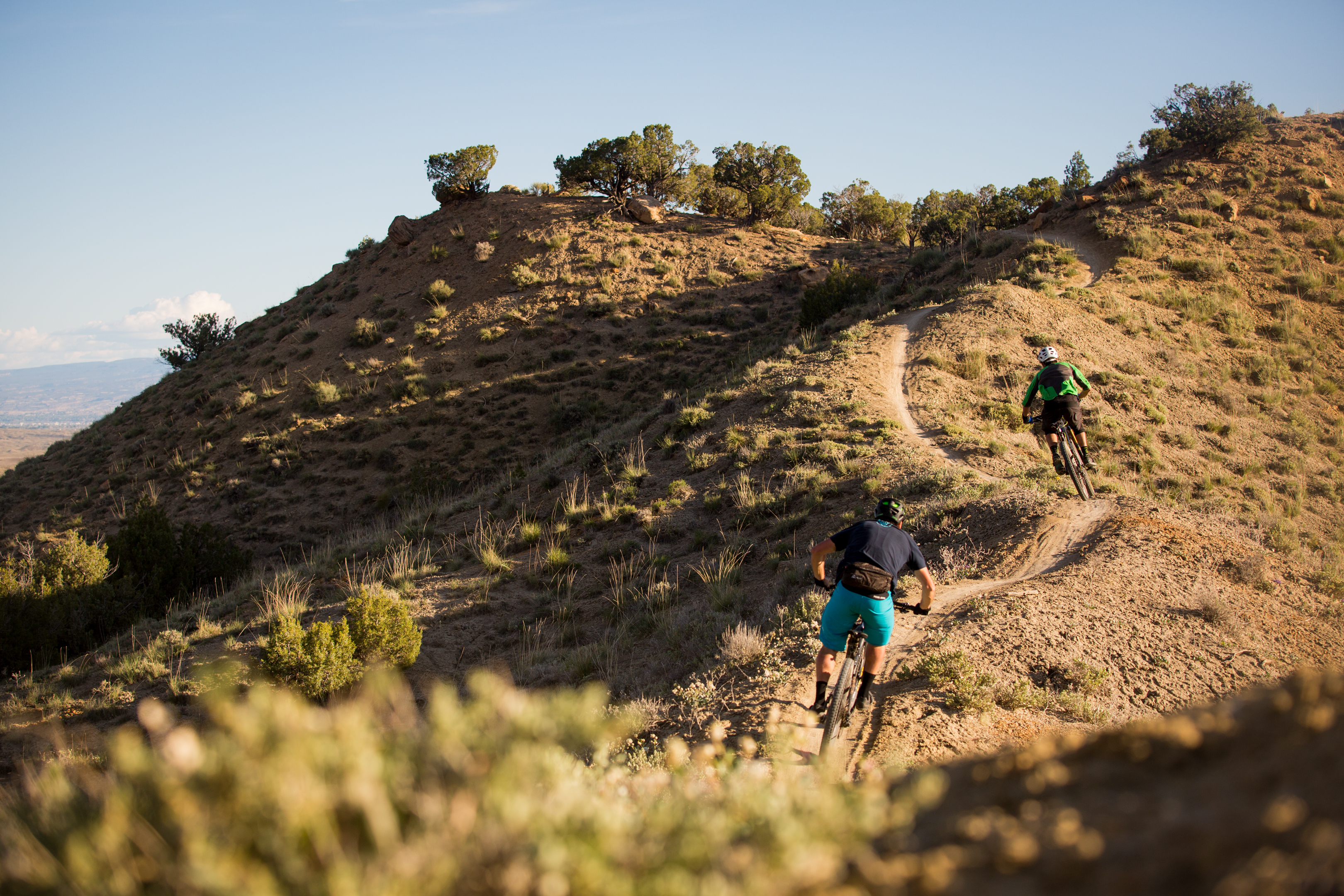
One of BLM's hottest mountain bicycling spots is the famous Slickrock Trail at Moab, Utah. It was built by motorcyclists, but in 1990 trail attracted 400 motorcyclists and 47,700 bicyclists. Many of mountain bikers are inexperienced, so there's a high injury rate on this expert route. A few cyclists each year are transported directly from the trail via helicopter to a Grand Junction hospital. BLM also faces a problem with the large numbers of people camping near Slickrock.
BLM employed mountain bikers to perform a mapping project on Slickrock Trail. The agency runs the national Cadastral Survey, which plots and records the boundaries of all federal lands. The Denver and Salt Lake City offices of the survey wanted to show how satellite positioning equipment can be used in remote, difficult areas. Working with an equipment manufacturer, BLM put transmitter units on bicycles. Cyclists then road all the routes at Slickrock. The signals sent directly from bicycle to space satellite revealed the cyclists' position to within 5 meters. The private Latitude 40° mapping company then took this accurate, computerized information, plotted it out, and superimposed it onto an aerial photo to create a beautiful map of the trail.
BLM is working to expand its canyon country cycling routes to other areas of the state. The agency is working with COPMOBA to create a 190-mile long route across the San Rafael Swell, an uplifted area in the middle of Utah. Cyclists may Eventually enjoy unpaved riding all the way between Moab and Salt Lake City.
Tools Of Management
In Durango, Colorado, BLM worked closely with the Forest Service, local bike shops, and racing organizations to put on the 1990 World Championships. During the races, BLM hosted a symposium for land managers on managing mountain bikes. Area Manager Sally Wisely then initiated a project to produce a video on the subject, which was completed with the Forest Service. The tape describes mountain bicyclists as "a hard group to pin down" because of our diversity. We are "one of the greatest challenges currently facing land managers." The sport is portrayed as upbeat, positive, wholesome, and environmentally sound. Mountain bicyclists "do not often stray from the beaten path," one speaker notes. Another likens off road cyclists of the 1990s to the backpackers of the 1970s, with "a similar mindset, a very environmentally sensitive group." The video encourages land mangers to "look before they leap into solving mountain bike issues ...to take a proactive stance and solve conflicts with logical and fair case by case decisions."
I hope all the California State parks managers get a chance to watch this videotape!
Wisely and her partners are also producing a handbook to show communities in the 4 Corners region how to make trails happen. She is working with Dove Creek, a small, economically depressed community, to build its cycling opportunities on new and existing trails. One neat ride there travels for 26 miles through the canyon of the Dolores River.
Preparing for the Golden State hordes
The California director of BLM's Mountain Bike Initiative is concerned about the potential impacts of the Golden State's huge numbers of mountain bicyclists. "Whereas Colorado desperately wants the use, we're not ready for it," said Dick Barber from the Sacramento office. "We want to have ourselves ready when we finally put the work out. Once we open the door here, people will be out after work or on weekends and we will get hit big time."
BLM is getting a good start in the Palm Springs Area. Bicycling groups got together and donated a bicycle for use by BLM rangers in the nearby Santa Rosa Mountains National Scenic Area. A multi-party partnership is identifying routes and delineating management responsibilities. "We have a lot of old jeep and mining roads. We want to make sure they're safe. We also have old cow trails. We want bicycle organizations to find those and tell us about them and let BLM get them onto our network," Barber explained. He added that BLM's efforts may take some of the pressures off other California lands, such as the highly used but controversial state parks.
In general, BLM needs to work in partnerships with bicyclists because the agency needs our input, said Barb Sharrow, assistant to Bob Moore. "A lot of us bureaucrats don't have time to ride." To further those relationships, BLM is staffing a booth at the bicycle industry's big trade show this fall in Anaheim, California. "We hope to talk there to a lot of big manufacturers and dealers and see if they are interested in helping volunteer groups get off the ground, so the volunteers can help us identify trails," Sharrow said.
She sees BLM fitting a niche for mountain bicycling because on most BLM lands, we can ride year round. And BLM lands are often not so pleasant for hikers. "Who wants to hike across ten miles of sagebrush? On a mountain bike, it's fun," she observed.