IMBA - International Mountain Bicycling Association
What would we do without trails?

The New Frontier
Are lift-accessed bike parks sparking a revolution?

By Mitchell Scott and Bike Magazine

View .pdf version with pictures

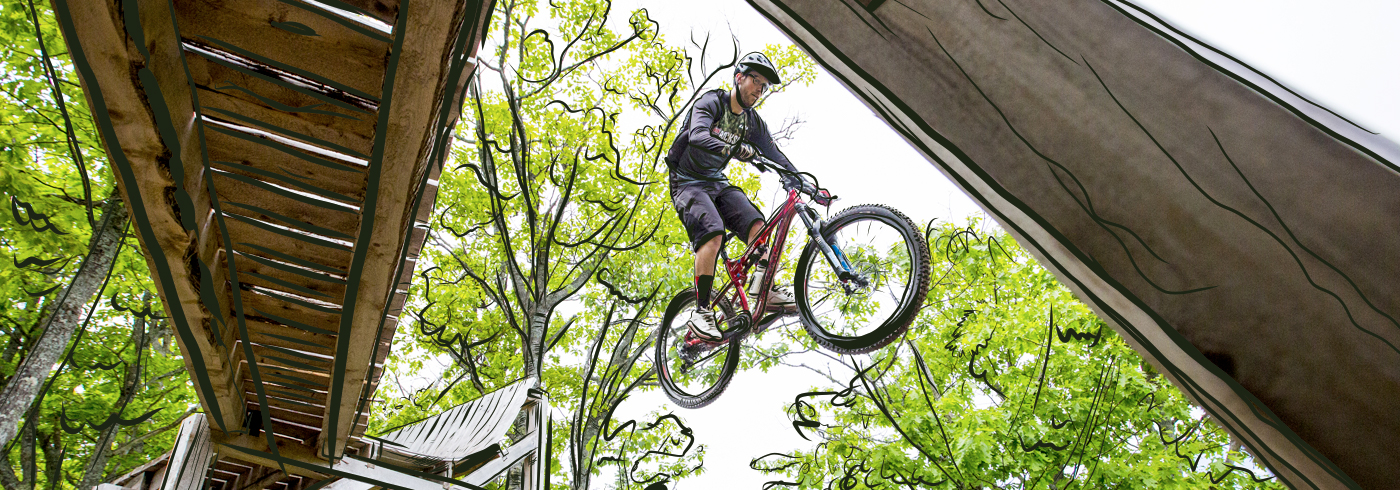
A-line is an addiction - a substance so good, it's bad. Riders who exit the lift at Whistler Mountain's bike park may force themselves to try trails like Joyride, Crack Addict or the less raucous B-Line, but they all cave to the call of those beautiful, rhythmic combinations of tabletops, hip jumps and deep berms. The park's draw is so powerful, A-Line probably had more traffic this past summer than any other mountain bike trail in the world.

The taste of dust and heat and sweat meanders through the lift line at Whistler's base like it does at most gatherings of the knobby wheel. But this is different. Seventy miles north of Vancouver, British Columbia, surrounded by the mega-peaks of the Coast Range, I am standing amongst hordes of A-Line addicts, and fast becoming one myself. Corralled toward the Fitzsimmons Express quad chair, I'm immersed in caged adrenaline. There is no riding up, no earning of kinetic advantage - just a gluttonous feast of cheap-won gravity. Hook your bike to the back of the chair, plop your ass onto padded vinyl and watch 1,200 vertical feet go by in five minutes - pure, unadulterated, downhill bliss delivered for less than the cost of a new tire.

If concerns of selling out exist, the throngs gathered in Whistler for the second annual Joyride Bikercross don't seem to care. The lure of a DH race on A-Line and a big air comp has attracted both local and international riders. Waiting in line are honchos such as World Cup DH champ Steve Peat, defending Joyride champion Dave Watson and Brian Lopes.

At the bottom of the bikercross course, a swarm of riders strut their full downhill regalia: $3,000 dual-suspension bikes, seats lowered, flat pedals holding skate shoes, flashy freeride garb covering body armor. Packs of kids peer through oversize full-face helmets to watch their heroes glide effortlessly across 30-foot tabletop hits. There are patio beers and blaring music. This is a scene. The typical mountain bike landscape - the one where you and your buddies hammer off into the bush for hours on end - is a galaxy away.

Cool for the 17-year-old air addict, but how do bike parks fit into the overall mountain bike arena? In Europe, parks have been popping up steadily at ski resorts in France, Switzerland and Norway for the last five years. In North America, resorts have allowed mountain bikes on their lifts for nearly a decade, but few have taken the major steps Whistler has. It's been a minimalist stab at accommodating a recently revolutionized sport. Yet while some resorts seem disinterested in developing freeride-focused trails, the winds of change are alight at Snowmass, Deer Valley and Mammoth.

It is a trend even sanctioned by the International Mountain Bike Association - the sport's leading trail-advocacy group. According to IMBA Communications Director Pete Webber, "With the growing popularity of freeriding and the fact that riders are seeking unique and highly challenging trails, ski areas can play a more important role than before. They have the ability to create specific freeride trails in a special-use situation much better than you can on public land." In the U.S., where many resorts have special-use permits with the Bureau of Land Management and Forest Service, this "ability" may be a bureaucratic battle. The size of local markets, liability issues and budgets are difficult challenges resorts must face.

Whistler Bike Park - and others, such as Portes du Soleil in Switzerland, which boasts 360 miles of trails and a slew of permanent downhill tracks, trials circuits and bikercross courses - represents the full paradigm shift. There is nothing else like it in the world. At Whistler, trail crews armed with mini-backhoes and quads build berms, gap jumps, stunts and steep, suspension-heady, technical descents. There are dual-suspension-riding bike patrollers and on-hill EMTs. There are 34 trails in the park, rated green to double black. You can buy a season pass. You can rent six-inch-travel, dual-suspension bikes, full-face helmets and body armor. You can even buy soda and fries at the top.

This past season, 50,000 rider visits were recorded at Whistler Bike Park. While it's a mere fraction of the numbers a successful winter season generates, it's still an amazing 65-percent increase from 2001. Their biggest weekend saw some 850 riders roll through the ticket window.

Since it opened four years ago, Whistler has quadrupled its visitors. Much of this increase is due to their progressive attitude. Last summer they hired Whistler local Richie Schley to design his "dream trail." He also worked with downhiller Andrew Shandro to run three weeklong kids' freeride camps.

Steve Peat took time out of his busy schedule for the Joyride Bikercross. "It's a great place to train, and one blast of a good time," he chuckles. "Shit, I'd stay here all year if I could."

Peat mentions just one of the many bike-park benefits. When considering the virtues of training, lift-accessed riding provides an arena unmatched. For a young racer or a middle-age freeride convert, riding the same jumps 10 times in one day (what would amount to 12,000 vertical feet at Whistler) will teach you things you never thought possible. As terrain parks infused both snowboarding and skiing with new energy, now there is a progressive venue focused on the evolution of freeriding.

Bike parks also encourage the growth of the sport. Lift access opens the doors to people who otherwise would not be interested in riding - simply because they're not willing to endure the pain of climbing up. "Just watching the evolution at the park is fascinating," explains Rob McSkimming, director of Whistler Bike Park. "You see people making the cross-country to freeride transition constantly. First day in the park on hardtails and spandex, next day full-face helmet and padding, then a dualie and full armor, then a bigger dualie and so on. Being in constant and obvious contact with those who are already ripping provides the catalyst for this transformation. Without parks, it would be difficult for these people to get exposed to the freeride scene."

Lift-accessed bike parks also foster other tangible benefits. Environmental impact is concentrated in an already developed location. Kids are riding in a controlled environment - patrollers, trail maps, signage and the availability of food and water are all significant to parents.

From an industry perspective, bike parks could play a role in increasing consumer spending. Equipment replacement, necessary after continuous, big vertical mileage, results in increased demand for quality products. In Whistler, shops such as Evolution have seen sales climb steadily at 15 percent over the last seven years. There are also tertiary spin-offs - most notably, the off-season traffic to ski resorts and towns often deserted in summer.

According to Jake Heilbron, chief operating bicyclist of Kona Mountain Bikes - the official bike sponsor of the Whistler Bike Park for the past three years - "We really feel that bike parks hold great possibility for the future of cycling. They have the potential to appeal to an entry-level rider, just like someone going to a ski resort and not really being a skier, but being able to do it. I think downhill mountain biking at a bike park like Whistler has the same kind of appeal. I think that's potentially huge for cycling - just recreational downhill riding. I know it doesn't fit in with what the purist vision of what a cyclist is, but I don't think there's anything wrong with it."

There are, however, cons to the bike-park deal. Four days into my complete A-Line addiction, I unwittingly entered this dark side of the phenomenon. Landing an air, I lost the grip of my handlebar and stacked hard into rock. The piling put a seven-stitch gash in my elbow, broke my thumb and dislocated my pelvis. During the six hours I spent in the Whistler medical clinic, I was privy to a parade of carnage: bruised liver, slashed wrist, broken shoulder, smashed jaw, a kid with 50 stitches in his face.

Injuries are the yang to Whistler's yin of success. This is not to say it, and other bike parks on the continent, doesn't have well-implemented safety programs. At Whistler, there is no place on the mountain you cannot be easily evacuated from. Jumps are all tabletops, so if you come up short there are no disastrous consequences. There are even training zones where you can increase your skills on jumps and stunts by starting small and building up.

Besides the injury issue, it is also a legitimate worry that the root element of riding - the getting on your bike and actually making it go uphill - will be threatened. Considering that 30 percent of American kids are clinically overweight, motocross is growing like wildfire and shuttle mania is already upon us, this argument seems moot. We should concentrate on getting people on bikes first, then worry about how or where they ride them. Even in Colorado, cross-country heartland, resorts such as Snowmass are jumping on the bike-park bandwagon. "We're pretty excited about how our bike park was received this year," says Steve Rausch, the man responsible for building Bonzai, one of the state's first freeride trails at a ski resort. "Guys were traveling from all over the region to ride it."

Like every new venture, there will be resistance as old mentalities are confronted. This new venture is one experimenting with a sport where technology and rider ability are calling loudly for something more. Until now, freeriding has been confined to backcountry and urban locations - jumps and lines reached only by hiking and shuttling. Now it has a legitimate venue, one that is social, controlled, safer and easily accessed. Because of this, bike parks have the ability to expose mountain biking to an entirely new cross-section of people. Whether that hurts our sport or takes it joyously to the next level is yet to be seen. One thing, however, remains certain: The world has an amazing infrastructure of ski lifts, most of which lay idle for half the year. If bike parks take off, and bull wheels nationwide start turning for skiing's summer brethren, imagine how bright the future will be.

North America's 5 Best Parks

While Whistler is North America's lift-accessed riding leader, there are a host of other ski resorts with notable bike-park programs. Here are the continent's top five.

Sun Peaks Resort, Kamloops, British Columbia
Nestled in B.C.'s sun-drenched southern interior, Sun Peaks is best described as Whistler's Mini-Me.
vertical: 2,000 feet / trail system: 24 trails,
25 miles of singletrack, a bikercross course, stunt parks, downhill course / lift system: One high-speed quad / best trail: Sugar / day ticket: $17 US / season pass: $127 US / season: June to September / contact: 800-807-3257, www.sunpeaksresort.com

Plattekill Ski Resort, New York
Two-and-a-half hours from New York City, it offers the largest and most challenging park on the East Coast.
vertical: 1,100 feet / trail system: 70 trails with 20 miles of downhill singletrack and more than 40 miles of cross-country / lift system: One triple chair, one double chair / best trail: Broken Tooth / day ticket: $23 / season pass: $249 / season: Mid-April to early November / contact: 607-326-3500, www.plattekill.com/bike

Mammoth Mountain, California
Some of the West Coast's best lift-accessed riding with freeride-specific terrain, dirt-jumping, downhill courses and plans for future development.
vertical: 3,100 feet / trail system: 80 miles of singletrack / lift system: One high-speed six-pack, two gondolas, shuttle service / best trail: Bullet / day ticket: $29 / season pass: $245 / season: June to October / contact: 800-MAMMOTH, www.mammothmountain.com

Ski Bromont, Quebec
Eighty-four miles from the U.S. border, Bromont has long been one of Eastern Canada's best and most progressive bike parks.
vertical: 1,853 feet / trail system: More than 60 miles of trail, including nine insane, World Cup-level downhill courses / lift system: One high-speed quad / best trail: Bonzai / day ticket: $17 US /
season pass: $109 US / season: May to October / contact: 866-BROMONT, www.skibromont.com/ang/velo/index.html

Deer Valley, Utah
One of the few resorts in the region, offering nine expert-rated trails.
vertical: 1,300 feet / trail system: 50 miles on 19 trails, rated green to double black / lift system: One triple chair / best trail: Fire Swamp / day ticket: $16 / season pass: $250 / season: Mid-June to late September / contact: 800-424-DEER, www.deervalley.com

Whistler Bike Park: 800-766-0449,
www.whistler-blackcomb.com/mountain/bike/

Email this page Printable Version


Help | Site Map | Copyright
IMBA Homepage Join IMBA Now!